
3D Cone Beam Imaging in Layton, UT: Your 3D Dental X-Ray Guide
3D cone beam imaging in Layton, Utah, provides a detailed, three-dimensional view of your teeth, jaws, and surrounding structures. This advanced 3D dental X-ray, often called cone beam CT (CBCT), helps plan precise treatment and diagnose complex conditions. Patients can expect clear images that support accurate decisions for implants, root canals, wisdom teeth, and more.
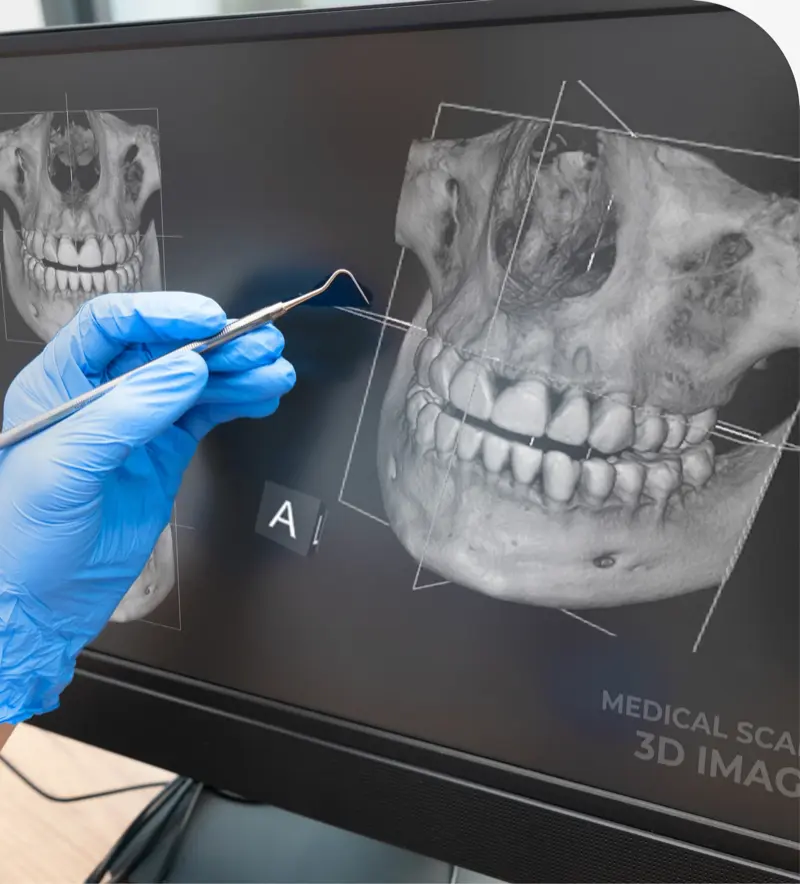
Cone Beam Imaging Explained
A cone beam CT is a specialized dental scan that captures hundreds of images in a single rotation, then reconstructs them into a 3D model. Unlike a traditional two-dimensional X-ray, CBCT shows width, height, and depth, revealing details that are not visible in flat images. Dentists use these scans to assess bone quality, nerve position, sinus anatomy, and the exact location of teeth and roots.
What is a cone beam CT compared to a panoramic X-ray? A panoramic image is helpful for an overall look at the jaws, but CBCT provides far more detail. It is especially useful when planning dental implants, evaluating impacted teeth, assessing infection or cysts, reviewing previous root canal treatments, and analyzing the temporomandibular joint.
How Cone Beam Imaging Can Help You
The benefits of a dental cone beam scan extend from diagnosis to treatment planning and follow-up care.
- Improved accuracy for procedures like implants and surgical extractions.
- Enhanced detection of infection, fractures, and root anatomy.
- Better evaluation of bone density and volume for grafting decisions.
- Clear mapping of nerves and sinuses to reduce procedural risks.
- Efficient planning that can shorten treatment time and visits.
- Targeted information that supports minimally invasive approaches.
How Cone Beam Imaging Works
The scan process is quick and comfortable. After a brief review of your medical history, you will stand or sit in the unit. A small bite block or chin rest helps keep your head steady. The scanner rotates around your head for 10 to 40 seconds, capturing data while you remain still. There is no sensation during the scan.
Images are processed almost immediately. Our dentist reviews the 3D views to answer specific questions: Is there enough bone for an implant? Where are the nerves near a wisdom tooth? How far has an infection spread? This information guides safe, well-informed treatment choices.
What to Expect
Most appointments take only a few minutes. No special preparation is required, but you will be asked to remove glasses, earrings, and metal hair accessories. If you are or might be pregnant, alert the team before imaging. CBCT does not use contrast dye and does not require sedation.
Regarding radiation dose, cone beam imaging uses more radiation than a single small dental X-ray but generally less than a medical CT scan of the same area. The scan is ordered only when the added detail is expected to improve diagnosis or treatment safety. This follows the ALARA principle: as low as reasonably achievable.
Did You Know?
Cone beam technology captures a full 3D view of your jaw in under 30 seconds, providing detail that traditional X-rays cannot match.
Got Questions?
Frequently Asked Questions
Yes. CBCT uses a focused beam to limit exposure to the area of interest. While the dose is higher than a 2D dental X-ray, it is typically lower than medical CT. The scan is recommended only when the benefits outweigh the risks.
The actual scan usually takes less than a minute. Most visits, including positioning and review, are completed in about 10 to 15 minutes.
CBCT is useful for impacted teeth, implant planning, root fractures, infections, cysts, sinus involvement, jaw joint evaluation, and airway assessments.
A panoramic X-ray is a broad 2D image that shows both jaws. CBCT creates a high-detail 3D model of targeted areas. Compared with medical CT, CBCT uses a cone-shaped beam and often has lower radiation for dental applications.
No special preparation is needed. Remove metal objects from the head and neck area and inform the team if you are or might be pregnant.
CBCT is not routine. It is ordered only when its detailed information is necessary to answer a diagnostic question or plan a specific treatment safely and precisely.
Need Advanced Imaging?
Call (801) 444-9090 or contact 4 Dental Health to schedule a cone beam scan in Layton, UT with Dr. Steven Christensen.